

On Agency
02026’s Prologue
You’re not insane. This is insane.
We typically analyze the overlooked here. And while what’s unfolding in Minnesota and around the world is anything but latent, it still feels under-discussed relative to its gravity. It’s worth clarifying — in repetition lies permission for more discussion.
The U.S. government is maliciously dividing and lying to its citizens, and those who dissent are indicted, intimidated, arrested, and brutally murdered in broad daylight. This manipulative social rupture — this fascism — inflicts psychic damage and disorientation to all. It’s by design. Federal employees cosplay as the Gestapo and the Stasi while our most powerful leaders gaslight their citizens fearlessly. Our values are never not under attack, but they’re increasingly so now.
We lack accountability — and the bravery and conviction that are the prerequisites for it.
There’s a line:
“They lie to us.
We know they’re lying.
They know we know they’re lying.
But they keep lying anyway.”
Unfortunately, there’s a storied history to its origin.
Alexei Yurchak coined the term ‘hypernormalization’ in 2005 while Adam Curtis popularized it with his documentary a decade later. The phrase described the phenomenon in Soviet Russia when its citizens carried on as normal while government and institution collapsed. Despite profound dysfunction, life remained humdrum and citizens repeated lies about what was going on that they knew weren’t true. But, collectively deluded, there were no other alternative futures to consider.
Hypernormalization implies a terminal condition. One where people know the lie they’re being fed is a lie, yet perform the belief anyway because imaginations are atrophied. It’s absolute cynicism.
I refuse to believe we’re amidst hypernormalization. That requires surrender — people who’ve stopped believing change is possible. Instead, I see people still processing and drafting an alternative — slowly, privately and without all the language quite yet.
ZINE asked over 100 senior researchers around the world — experts with 10+ years experience analyzing culture — “What is the most defining word of our moment?”
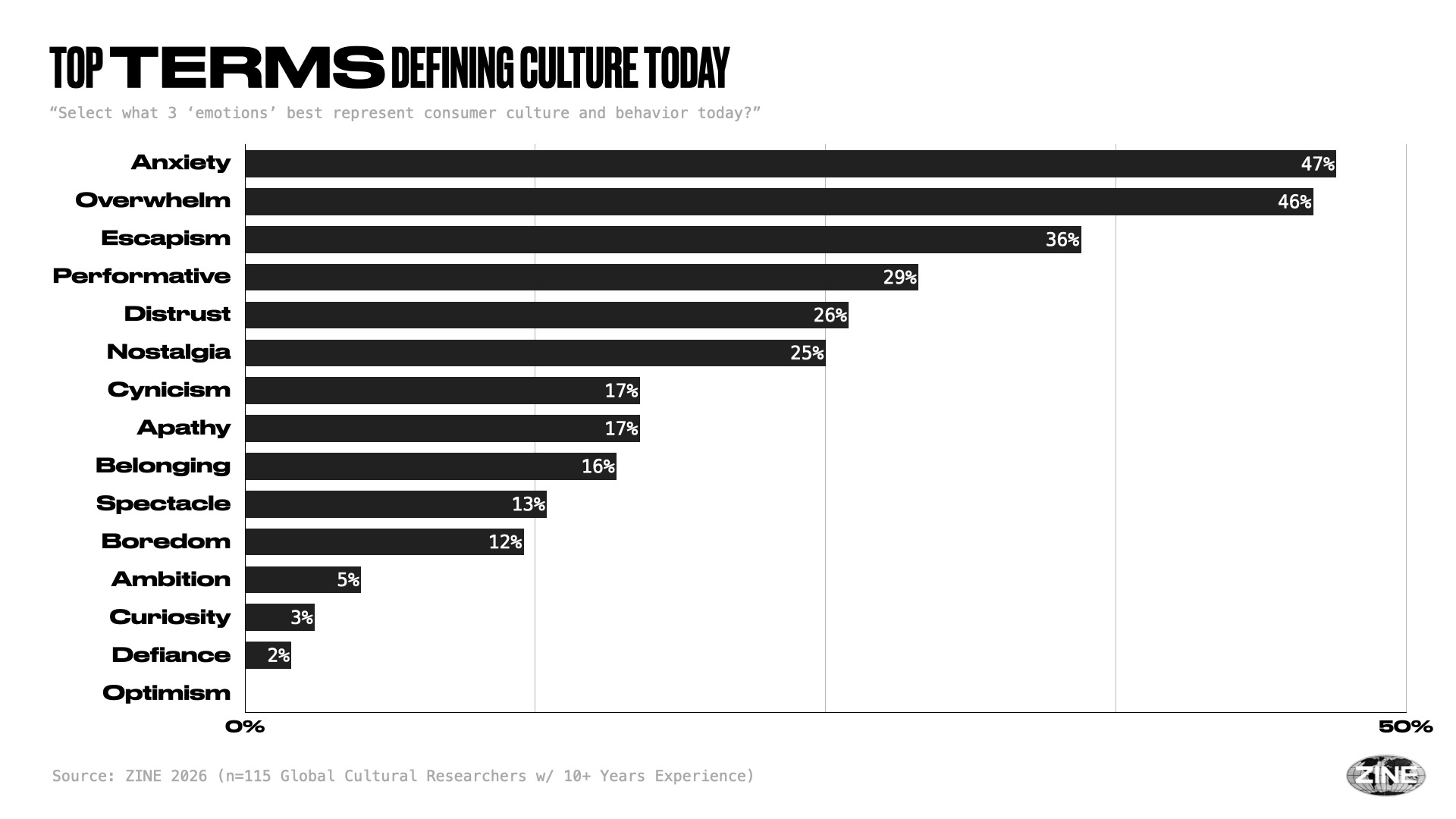
The most reported answers were ‘Anxiety’ and ‘Overwhelm.’
Untreated, these maladies produce paralysis — the conditions for hypernormalization. We shut down not because of numbness, but because of too much all at once. Understanding this effect helps us prevent inaction, becoming victims. If we keep moving, metabolizing, talking and channeling energy productively, the paralysis won’t take over. Meanwhile, terms like ‘Apathy,’ ‘Cynicism’ or ‘Boredom,’ which illustrate the full effects of hypernormalization, score low.
There’s a power in naming these emotions and what’s unfolding here, because at a minimum, they help us feel less alone. Less shell-shocked.
There are some reframes to hypernormalization that may also be beneficial. Like Antonio Gramsci’s concept of the interregnum — a transitional crisis where an old, established order is dying with morbid symptoms, but a new one cannot be born. Perhaps we’re mid-blink — a society flinching, still determining what it’s seeing and how to react. Or call it narrative lag — our events have outpaced the stories and terms available.
We may lack the words, but not the foresight...
As heinous as today’s actions are, they’re anything but unprecedented. “Gaslighting” was Merriam-Webster’s 2022 word of the year. We’ve been living through (and thinking about) these conditions for years: truth wars, surveillance states, cravings for new religion, revoked inclusion, the symbolic disinterest in collaborative environmentalism, the collapse of constructive conversations, burnout on the future, the optimization of spectacle, and entrance into Dark Mode.
Most recently, we’ve dissected the collapse of consensus through the lenses of: manipulation, attention wars, loss of senses, and how stripping away friction strips away our shared reality.
An oversight may have been framing these futuristically as ‘trends,’ when in reality, they’re already fully metastasized facets of our society.
In the prologue to META Trends three years ago, I shared the idea of ‘Discordianism’ — a claim that chaos and disharmony are essential to our reality, just as other religions claim harmony and order are. As I wrote,
“Disorientation is now our norm – we’re chronically dazed, drowning in unpredictability. For many, fictional explanations were (and remain) more believable than truth itself. Reality is too strange to be this real.
[But] accepting chaos does not mean forfeiting control. We often forget that we maintain control over our systems and culture. Nothing is fixed.
In the face of overwhelming Discordianism, ‘Meliorism’ is our antidote: in between optimism and pessimism, it declares that our world can only improve with human effort.”
I still believe this... which then raises the question, “Well, what do we do now?”
There are plenty of proposals, but I’ll offer a few personal, evergreen additions:
Find grounding, embodiment and community — real community with physical presence and eye contact.
Place passion into something. Energy needs a home and catharsis.
Keep living. This isn’t ignorance, but maintaining (remaining) stability. Newspapers still have a sports section despite what’s on the front page.
Remain present. Instead of getting caught up in the future — which can’t exist without this exact moment — can we come back to this second?
Metabolize however you need to and don’t let anyone else tell you the “right” or “wrong” way to process the moment. For as long as there’s awareness and reflection, metabolize uniquely to model and make room for others to do the same — ideally together.
Our overwhelm isn’t ceasing. We look down the barrel of utter environmental collapse, an isolation crisis, more wars, and AI, which we’re told will destabilize our economies and intuition itself. Meanwhile, AI dredges up our past, making it even harder to imagine anything that hasn’t existed.
Symbolically, both hypernormalization and AI struggle to generate radically new futures.
Hypernormalization is one possible future. As is one where all decision-making, companionship and entertainment is outsourced to an enshittified chatbot. But neither are fully here, and neither have to fully arrive. If we get to author our preferred futures, then we best start thinking what’s next.
As always, rather than seeing trends as an answer key to mindlessly copy or relinquish control to, can we reclaim the pen and begin blueprinting the worlds we wish to see instead?
Intolerance saves us. And agency remains available.
We should use it while it’s still ours.

Q: WTF are META Trends?
A: META Trends are an annual and manual distillation of the industry’s most frequently reported trends, answering “What’s most repeated across 70+ trend forecasts?”
Why in the world would you read all these reports and not just throw them into AI? AI doesn’t work here.
For this task, human intuition far exceeds even the most advanced AI models. Cultural intelligence and sensemaking cannot be wholly outsourced to something that isn’t living what it’s reporting on.
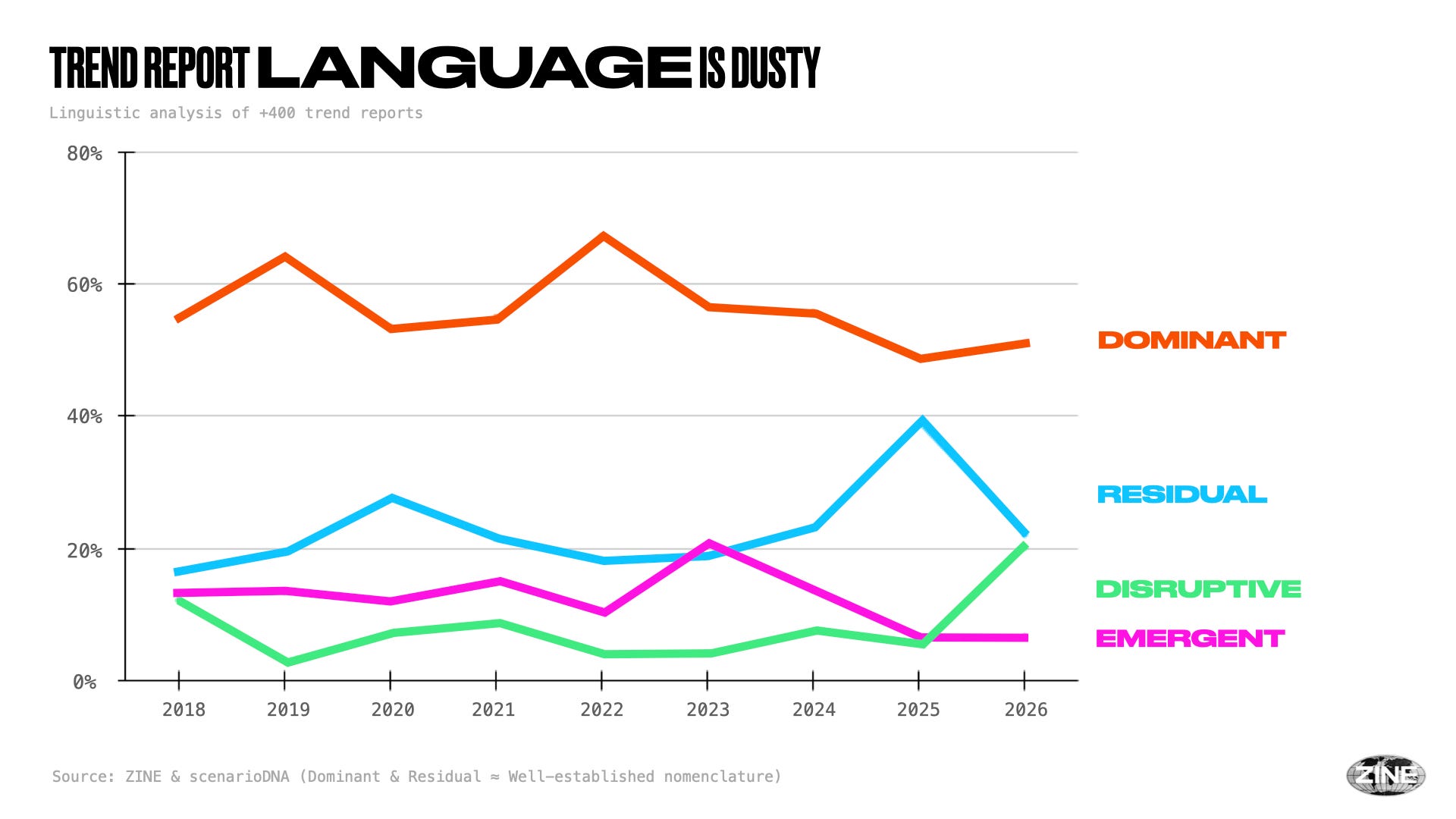
The intent from my first META Report in 2017 was that we can leverage reliability (all available reports) as a proxy for trend forecast accuracy. But over the years, I’ve found significant systemic flaws in these reports (ex. lack of methodologies, geographical and commercial biases, hyper-positivity, fear of risk, and perpetuated hype.) In further analysis, the vast majority of reports reveal “Dominant” or “Residual” language — i.e. well-established nomenclature... despite their task of reporting on the exact opposite.
“Accuracy” now has an asterisk.
But then why keep going?
The META Report still provides significant value, exposing the collective’s outlook (with a ~3YR horizon). META Trends must not be considered the final answer key, but just the beginning of a strategy.
So... Three ways to approach The META Trends Report:
Consider all that’s reported as table stakes – catch up
Interrogate what’s presented — consider all other angles
Use this report as a filter — consider what’s not discussed
Or, bring it to life, discussing the nuances, changes in META Trends over the last decade, and tailored implications to your organization or clients...
META Methodology
Read 70+ 2026 global reports and parsed 400+ trends in Excel 1
Analyzed trend descriptions to manually identify themes
Named 9 META Trends (i.e. largest themes or “trending trends”)
Analyzed original text to ID most common words per META Trend 2
Analyzed keywords to quantify size (per META Trend)
Used proprietary AI with Growth Protocol to score each collection of keywords: 3
“Human Rank” = published reports’ trend mention frequency
“Data Rank” = measurement of keyword volume across sources
Interrogated and elevated each META Trend beyond clichés

The 9 02026 META Trends:
01. Goosebumps 👋🏽
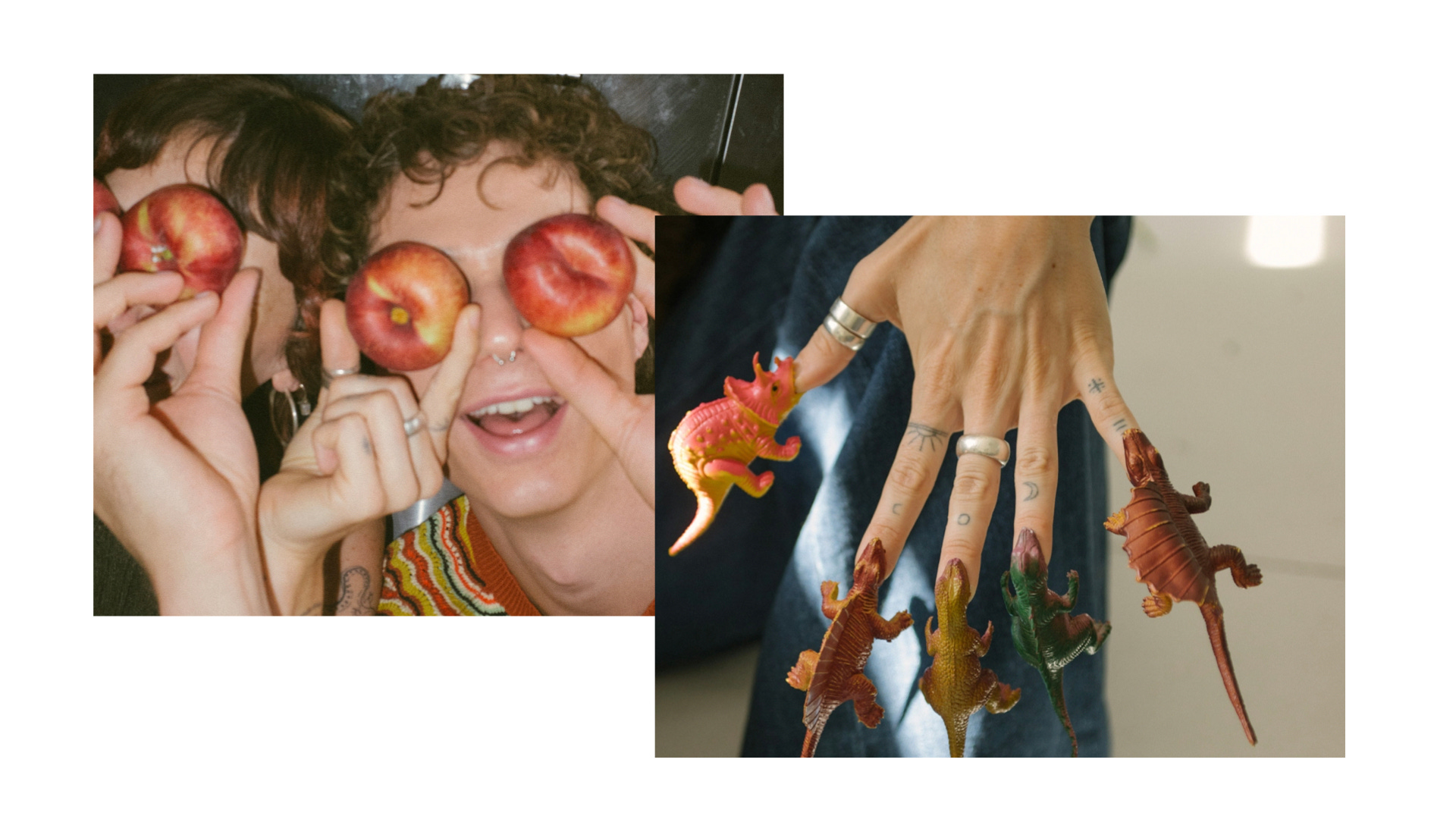
Unflattened, imperfect human characteristics warm us amidst frigid glass screens, AI, and division
Human Rank: 1/9 4
Data Rank: 7/9
Vocab: Somatic, Smudge Value, Analog Alternative, Flesh vs. Feed, Embodiment, Humanness, Unflattening
Biggest Keywords: real, touch, body, creator, personal, analog, sensory, quirky, playful, ambiguity
Drivers: AI & Bots, Starved Senses, Loneliness
Human Needs: Presence, Humanity, Nuance
To Resonate:
Reveal imperfect seams. Proof of craft, production and effort become invaluable demonstrations of humanity.
Design for ambiguity. Not everything needs an explanation. The opportunity for interpretation invites participation.
Let taste reign. Allow souls, not algos, to make the edit. Bet on POVs.
Elevate vulnerability as a value. Admit uncertainty and acknowledge limits. Build for trust over perfection.
Become a paid subscriber to access the full report.
Join Hundreds & Subscribe to Unlock:
🔓 All 9 ‘26 META Trends & Strategies
📂 All 9 years of META reports
🔑 Full ZINE archive access (+120 analyses)
Deep dives to understand cultural contexts
📬 Future supporter-only ZINE pieces
🎤 Best rate on META briefing workshops
🏷️ Discounts on special projects, events and seminars
🤗 That warm feeling from funding things you enjoy
❤️ My deep appreciation for supporting this passion