


This is the third report collaboration between ZINE x YouGov, an initiative studying under-surveyed cultural phenomenon. Previous studies investigated shame, demographics and the role of business, and self-reported AI-content detection skills and responses.

Cory Doctorow coined “Enshittification” to describe the gradual degradation of products and services in pursuit of profit. Since being named “Word of the Year” by the American Dialect Society in 2023, its only grown – both in use and the experience itself.
But while enshittification has been a revenue strategy for businesses and a cost to the consumer, few have considered the cost to businesses.
ZINE commissioned YouGov to survey over a thousand Americans to study the stakes of enshittification. We asked how people believe companies weigh growth against consumer value, what they’ve done when a product or service got worse, and what would cause them to walk away from a brand.
Growth > Experience

62% of Americans believe most companies prioritize growth even when it hurts the customer experience. A quarter believe companies at least attempt a balance. But only...
<2% of Americans believe companies prioritize the customer experience, even if it may slow their growth.

Decades of “the customer at the heart of all that we do” mission statements on HQ walls have yielded a population which believes none of it.
In its latest wave, The National Customer Rage Survey found that 77% of American consumers experienced a product or service problem in the past twelve months. This is the highest in history – more than double since 1976.
Fifty years of CRM software and journey mapping later, the same study puts revenue risk from poor complaint handling at $596B. Meanwhile, according to PwC’s latest Customer Experience Survey, roughly nine in ten execs believe their customer loyalty has grown in recent years. Nice work.
Receipts

The consumer belief and the executive illusions would be survivable if they remained just that — thoughts. But they haven’t.
81% of Americans have acted against a brand in the past year because a product or service got worse.
Not considered.
Actually acted.
In the last year:
45% cancelled a subscription or stopped using a product or service entirely
38% decided to “never return” to a brand
35% delayed or avoided a purchase
35% left a negative review or told others
26% downgraded to a cheaper option within the same brand
24% defected to a smaller or local provider
17% spent more money with a competitor
Or the best...
12% switched to a more expensive, higher-quality alternative
One in eight Americans are now paying a premium to escape enshittification.

Personal vendetta shout-out to fitness app Strava, which, while preparing for an IPO, made its app so fucking unbearable that I’ve stopped paying for a subscription after nearly a decade.
Enshittifiers lose to whoever still bothers with craft.
But it takes too long for anyone with a dashboard to realize this. A delayed purchase or warned friend doesn’t read as “consequence of Q2 cut corners.” Instead, the metric that justifies the cut is sought out and the metric that captures resentment isn’t.
As written years ago in Corporate Self-Sabotage:
“We’ve sacrificed the attributes we care most about (resonance, loyalty, fandom, influence and impact) for the metrics easily available to us.”

And don’t think you’ll hear about this in emailed surveys. According to Qualtrics, consumers giving feedback is at an all-time low. Why would they if they’ve concluded you’ve stopped listening? So, reasonably, they stopped talking.
Generational Tripwires

What would make people walk away from a product or service they already use?
65% would leave over prices rising without clear improvement, and 65% over quality declining while the price holds or climbs.
Shrinkflation is a pan-generational sin.

Younger people punish digital extraction — 53% of Gen Z would walk over features moved behind a paywall (vs. 31% of Boomers). And 40% of Gen Z would leave over more ads and upsells (vs. 24% of Boomers). Younger demo’s grew up fluent in the playbook – free, then friction, then fee. They now know exactly when to jump.
Older people punish dehumanization — 54% of Boomers and 50% of Gen X would leave a brand over hard-to-reach customer service (vs. 27% of Gen Z). 40% of Gen X would also leave over feeling like “just a number,” nearly 2X Gen Z’s 21%. Older demo’s who remember being valued customers are most sensitive to when their humanity is stripped from them.
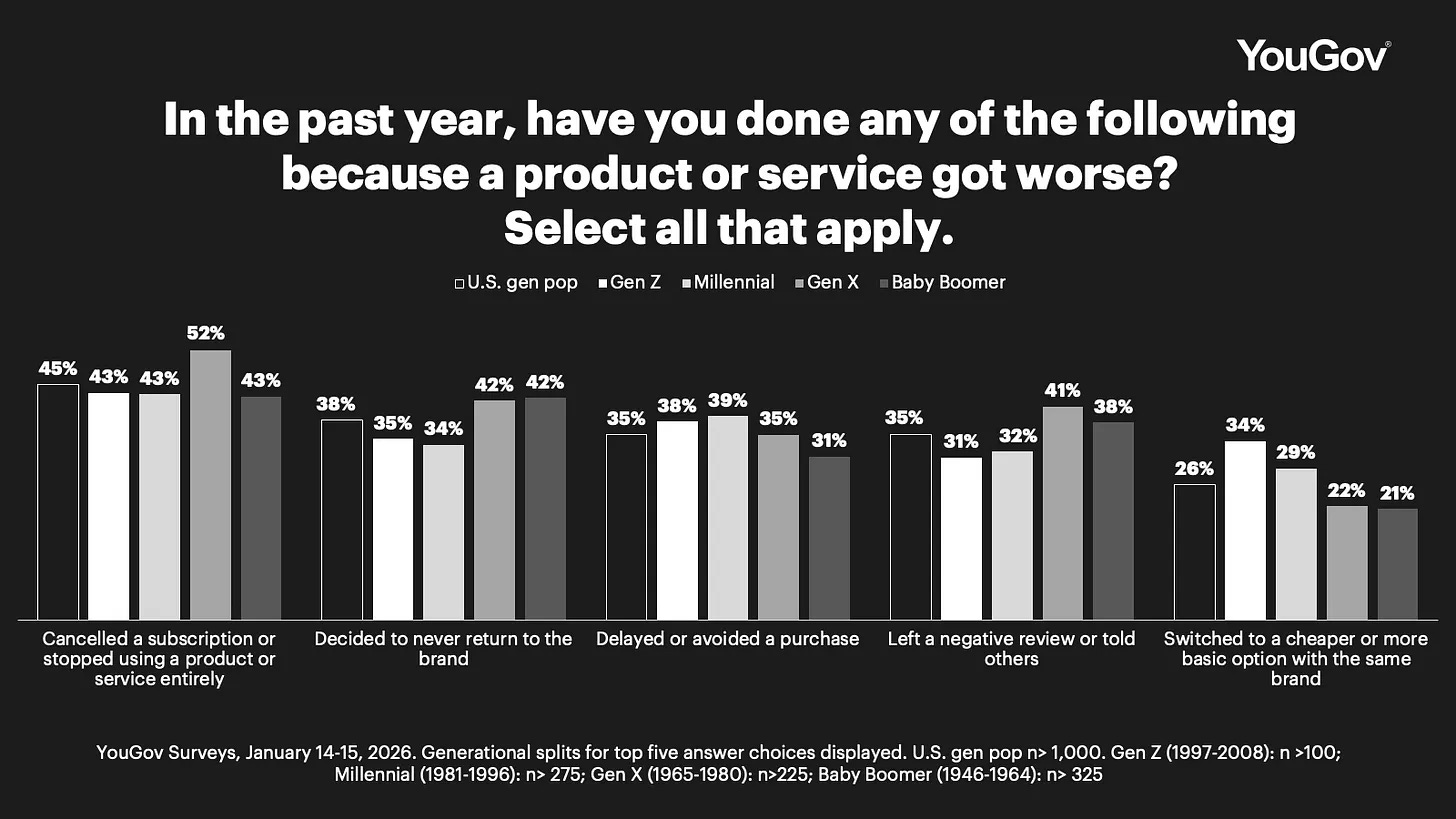
Gen Z is also most likely to downgrade within a brand (34%) or redirect spend to a competitor (23% vs. Boomers’ 11%), while Gen X and Boomers are most likely to never return (42% of each).
There’s no forgiving segment.
The Mea Culpa Economy

01. Klarna
BNPL platform Klarna spent two years as the loudest evangelist for replacing customer service with AI. They boasted its chatbot did the work of 700 agents. Sick. By 2025, its CEO told Bloomberg that this cheaper approach actually produced “lower quality” (fucking shocker), and investing in human support was the their new strategy.
02. Chipotle
“Ya’ll skimping on chicken!” read the TikTok captions. But Chipotle denied its portions had shrunk. A Wells Fargo analyst weighed their bowls and then consumers weighed in louder. The apparent strategy of going light on guac scoops — and then downplaying the consumer backlash — sparked a class action lawsuit against Chipotle. On their Q2’24 earnings call, leadership conceded that some locations needed retraining, insisting “generous portion is a core brand equity of Chipotle.” Chipotle won the lawsuit, but lost the reputational battle.
03. Starbucks
In 2024, Starbucks traffic was declining and a new CEO was installed to reverse years of its efficiency-first operations. He admitted, “We’ve made it harder to be a customer than it should be.” The company had been run like a manufacturing facility instead of an intentional customer experience. The new strategy was “Back to Starbucks” – a billion-dollar program, which added back what their hyper-optimization removed: human touch. Six quarters later, the company posted its strongest U.S. transaction growth in three years.

Obviously, current customers will see more “value” in a brand vs. its former customers (or vs. gen. pop.). But Starbucks’ former customers now experience a 60-point difference in perceived value vs. their current customers. And these former customer scores are even lower vs. gen. pop. perceptions. In other words, if you rip off your current customers hard enough, you’re facing a long, long, expensive journey to win them back... if it’s even possible.
Labor, volume and humanity were all cut, but the story arc’s always the same: optimize, hemorrhage, concede, rebuild at a premium.
Lucky for Klarna, Chipotle and Starbucks, they course-corrected themselves. When enshittifiers don’t act quick enough, the bill arrives another way
In September 2025, Amazon agreed to a record $2.5B FTC settlement – a $1B civil penalty + $1.5B in refunds to roughly 35M customers for their shitty Prime cancellation practices. Sign-up took two clicks. Cancellation took a four-page, six-click, fifteen-option gauntlet. Amazon itself nicknamed it “The Iliad Flow” after Homer’s epic.
Explanations (& The Permission to Slow)

Forrester’s Customer Experience Index has now declined for four consecutive years, sitting at another all-time low in North America. The gap is widening between what experience executives believe they’re delivering and what customers are receiving. By Forrester’s count, only 3% of companies qualify as “genuinely customer-obsessed.”
Qualtrics estimates $3,000,000,000,000 in sales is at risk due to these experiences.
The impact of caring has also been quantified.
Bain’s Frederick Reichheld showed that a +5% improvement in customer retention lifts profits +25-95%, and acquiring a new customer runs 5-25X the cost of keeping one. Meanwhile, ACSI’s portfolio of customer-satisfaction leaders returned a cumulative +2,340% from ‘06 to ‘26, against +675% for the S&P 500. Long short: satisfied customers beat the market.
So then why does the degradation continue when the consequences are so obviously painful and the upsides are so fruitful?
Again, enshittification is legible to customers, but invisible to dashboards. No one gets fired for shipping a revenue-generating cut. Rather, you’re incentivized to. Measuring the upsides is where focus is. This is another outcome of “Dashboard Culture” — the prioritization of data legibility... and optimization of behaviors that yield legible results.
If you can’t see the downsides, they don’t exist.

We also do things not because they work, but because everyone else is doing it. Shrinkflation is a “best practice” — as are the chatbots, cancellation mazes, and paywalled features. We’re now redesigning websites so AI can scrape it better, despite consumers struggling with a worse UX.
That everyone is enshittifying in unison doesn’t make enshittifying any more logical.
Private equity is another explanation for our continued enshittification. PE has roughly doubled in five years to ~$8T under management. A record +13K U.S. companies are now PE-owned (ex. the dentist, nursing home, local restaurant chain, and nearly half the country’s daily newspapers).
Customer relationships that compound over a decade are meaningless when a fund’s return horizon is just a few years.
PE-induced enshittification means literal death.
An NBER (National Bureau of Economic Research) study by economist Atul Gupta found PE acquisitions of nursing homes increased short-term patient mortality +10% (or +20,000 additional deaths over 12 years). Another JAMA/Harvard study found hospital-acquired conditions (ex. falls, infections, etc.) also rose +25% after PE takeovers.
The system that doesn’t care about nana sure as hell doesn’t care about your Karen-coded customer complaint.
So, while everyone is focused on shortcuts at the expense of quality, customer service, or life itself, the alternative has never been more lucrative.
If 62% of the public assumes you’ll sacrifice them for growth, the bar for not doing so has never been so low.
Care, craft and humans can be costs, or they can be your moats.

Here are 7 dumb-simple strategies and ways of thinking to prevent all of this rot. After causing the enshittification, McKinsey would charge you $400,000 for this: