

A Report on AI Content Detection & Reality
A national survey on our ability to identity what's real
ZINE commissioned YouGov to survey over a thousand Americans about their encounters with suspicious online material. The kind where you just can’t tell if something’s created by AI or not. Is this... legitimate?
The upside of our bottom-up media environment is that anyone can contribute. The downside is that anyone can contribute. Sifting for truth amidst slop, noise, propaganda and nonsense is now Sisyphean. How are we coping – or, rather, reporting on how we’re coping?
In our research we examined how often people come across questionable content, their confidence in detecting AI-generated material, and ultimately, what they do when they come across material they’re unsure of.
What we found says less about AI than it does about how people report their relationship to reality.
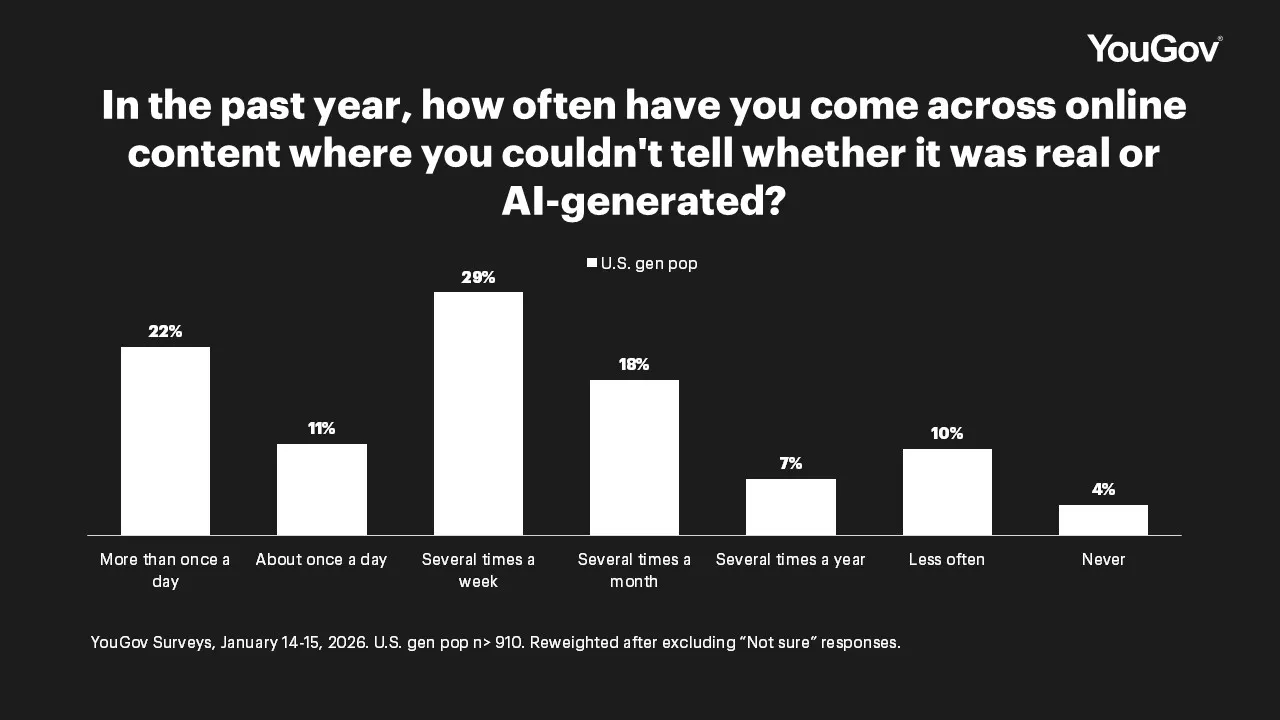
Firstly, more than half (61%) of Americans report they come across content they can’t tell is AI or real multiple times a week.
Nearly 33% of Americans are unsure about content on a daily basis.
Uncertainty is now routine.
When it comes to detection, 59% of respondents say they’re “Confident” they can distinguish between real and AI-generated content, while 41% say they are “Not Very” or “Not at All Confident.”
However, the bulk of this confidence is hedged into “Somewhat Confident” – which, when paired with such high rates of encounters, suggests we’re only capturing moments when suspicion is consciously registered. True exposure to AI-generated content is likely much higher.
Put a different way, the figure of “59% report confidence in their detection” doesn’t reveal their accuracy of discerning real vs. fake, but rather how often someone is aware of their own suspicion. Or really, how often one claims they’re aware of their own suspicion. This distinction is meaningful as we dive in...
Age
Older generations report encountering suspicious content far more often than younger ones.
Only 20% of Gen Z encounter AI-ambiguous content daily, compared to 25% of Millennials, 39% of Gen X, and 41% of Boomers. When it comes to those who report multiple encounters a day – the gap is stark: 10% of Gen Z vs. 29% of Boomers. A 3x difference.
One reading is that older cohorts may be more sensitive to the threat of fake content – more aware of their own susceptibility. Any time something appears slightly off, it registers. Heightened vigilance can translate to inflated reported moments of “I can’t tell.” (Or it just may be that their unique media environment has higher volumes of suspicious content...)
Conversely, digitally literate populations report they can more easily tell what’s real or fake. After all, younger cohorts also report higher confidence in their detection abilities vs. older cohorts – 72% of Gen Z say they’re “Confident” they can tell the difference vs. just 53% of Boomers. Younger cohorts have developed quicker instincts. Glance. Categorize. Keep scrolling. With that, they may be less likely to report their suspicion. Detection is automatic and doesn’t register. However, we also have to consider the likelihood of over-confidence.
These self-report biases work in opposite directions. Older generations may over-report encounters with AI content, while younger generations may under-report encounters with AI content. We don’t know which bias is stronger. And the real rates likely sit somewhere between what people claim they noticed, and what they actually encountered.
Action
So what happens when people come across this suspicious content?
An astounding 52% of the public claim they actively “Search to Verify” content they’re unsure about.
Given the time and cognitive effort this verification requires, this figure is certainly inflated. Remember, a third of the country says they come across questionable material daily.
In a prior ZINE analysis, it took hours to validate a single statistic, which sounded strange...
Intimately knowing the effort required... I call BS.
Meanwhile, 23% of people report they “Ignore and move on” anytime they come across questionable material. This is likely underreported.
Also, 12% of people automatically presume questionable content is fake vs. 2% who presume it’s real. Put another way:
Americans now default to “This is fake” six times more often than they default to “This is real.”
Default skepticism now defines our moment online. This scale of distrust is remarkable.
When it comes to gender differences, men are more confident in their ability to detect fake content than women (63% vs. 54%) – no surprise with their over-confidence. Men are also slightly less likely than women to engage in acts of verification (58% vs. 61%). And when it comes to default positions, men are more likely to “Assume it’s fake” than women (14% vs. 10%). This is noteworthy, considering men are more likely than women to report coming across this suspicious content several times a week or more (65% vs. 58%).
So... men feel more confident in their ability to detect suspicious content, encounter more of that content than women, and engage in less verification. (Let’s come back to this in a second...)
Politics
When it comes to political ideology, three findings stand out.
First, Moderates report the lowest confidence in their detection ability (6% are “Very Confident”) vs. both ends of the political spectrum (11% of Liberals are “Very Confident” and 10% of Conservatives are). Ideological certainty seemingly maps to detection certainty.
Second, 63% of Liberal respondents claim they search to verify content, while only 42% of Conservative respondents do – the largest demographic gap in the entire dataset.
And third, that verification gap is a media-trust gap. Conservative respondents default to “Assume it’s fake” (14%) more likely than Liberals (11%). Conservatives are also more likely to “Ignore and move on” than Liberals (33% vs. 16%).
Liberals may assume a credible source exists somewhere out there. Conservatives may not. Searching for the truth in a system you’ve already concluded is rigged isn’t time well spent. So when the default epistemic posture for a significant fraction of the country is “default fake,” legitimate content begins getting rejected at the same rate as illegitimate content.
And this is where we’re at.
A Truth
Let’s attempt to square these patterns...
Younger cohorts report less exposure to questionable content and higher detection confidence. Older cohorts report more exposure, lower detection confidence. Exposure and confidence invert.
But in the gender analysis, men report both more encounters and more confidence. Women report fewer encounters and less confidence. Exposure and confidence move together.
Then, political ideology introduces a third pattern. Confidence doesn’t track with exposure, but instead to larger narratives of political conviction and media distrust.
Three demographic cuts reveal three unique relationships between what people see, feel and report.
These contradictions are the conclusive insight:
We see AI as we are.
Different demographic groups carry different self-reporting pressures. Under threat, Boomers may feel permitted to admit they can’t tell what’s real. Gen Z may feel pressure to posture digital fluency. Men may feel pressure to claim technical proficiency. Conservatives may feel more distrustful of mainstream media. Liberals may feel pressure to claim they engage in diligent verification.
Is this survey deceitful data about how we handle deceitful content?
What this data captures isn’t actual exposure to AI-generated content nor people’s true detection capabilities. It reveals how culturally-influenced our self-reporting is.
It reveals our unique relationships to reality itself.
Our conversations about AI content are filtered through what people think they see, and think they can manage. And this filtering is happening way before any piece of media arrives in someone’s feed.
We’re building policy, comms strategies, AI detection tech, and media literacy programming on top of survey data which only tells us about self-perception – not actual exposure, not actual susceptibility, not actual detection.
Our perception of AI is shaped more by identity than reality itself.
Or as an unverified source once put it,
“We don’t see things as they are, we see them as we are.”


